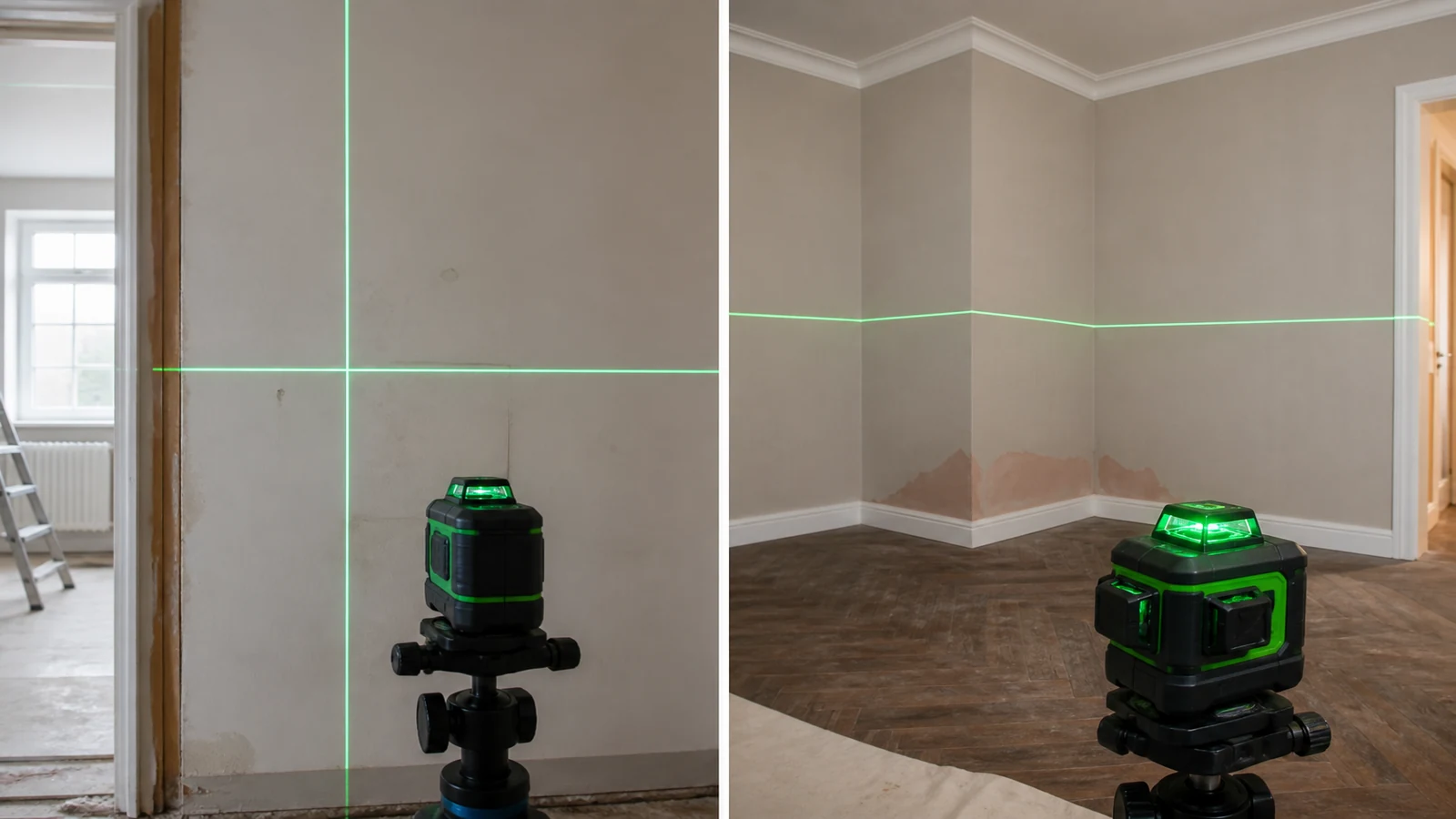
Cross line vs 360 laser level UK: choose by the room, not the hype
Short answer: choose a cross-line laser for one wall, one run of shelves or a straightforward feature-wall job. Choose 360° or multi-plane coverage when the same level needs to continue around a room, across cabinet runs or through a partition layout. The useful difference is how many times you must reposition the tool, not the biggest number printed on a box.
The practical comparison
Buying guides commonly separate cross-line tools for focused, single-wall work from multi-line tools for room-wide layout; see this cross-line and multi-line buying guide. Use the table below as a workflow check rather than a specification contest.
| Your job | Usually enough | Why | Upgrade trigger |
|---|---|---|---|
| One wallpapered or painted wall | Cross-line | A single vertical and/or horizontal reference is in view. | You need the line to continue around corners. |
| A row of shelves or pictures | Cross-line | The reference stays on one wall and setup is quick. | Several walls must share one height. |
| Kitchen wall units around a return | 360° horizontal | One datum can stay visible while you move around the room. | You are repeatedly moving a cross-line to preserve the same height. |
| Stud, dry-lining or room-wide tile set-out | Multi-plane / 360° | Vertical and horizontal references can be held together. | You need a floor-near line as well as wall references. |
| Outdoor grading or long-distance exterior work | Neither by default | That is a different use case with its own visibility and receiver needs. | Choose purpose-built outdoor equipment. |
What changes in real work?
A cross-line tool is deliberately simple. Place it, let it settle and work from the intersection on the wall in front of you. It suits tasks where changing position is no hardship. A 360° line earns its place when moving the tool would make you recreate the same datum around a corner or on the far side of a room.
That distinction matches broader buyer guidance: a laser-level buyer overview notes that a cross-line meets many ordinary jobs, while 360° coverage helps where lines are required across multiple walls. It does not mean 360° is automatically more accurate, tougher or better value; those are separate questions that need the actual model information.
Take the shortest decision path
- Count the walls that must share the same line.
- If the answer is one, start with a cross-line unless a future job clearly changes the case.
- If the answer is two or more, ask whether you will lose time resetting the tool at every corner.
- If you need a continuous cabinet datum, inspect the room-wide approach in our kitchen-cabinet layout guide.
- If you need vertical and horizontal set-out for a partition or boards, see the dry-lining workflow.
Do not confuse coverage with a buying promise
More planes can make a complex indoor layout easier to see, but they also add choices: which lines you need, how you will mount the unit and whether the kit contains the accessories your job needs. Read the selected variant and manual rather than assuming every multi-line listing has the same layout, battery arrangement or tripod.
If you have established that room-wide coverage is genuinely useful for your work, you can review this site's 16-line green laser level kit as one relevant product-detail page. Use it as a fit check for the task, not as a reason to upgrade when a one-wall cross-line already solves the job.