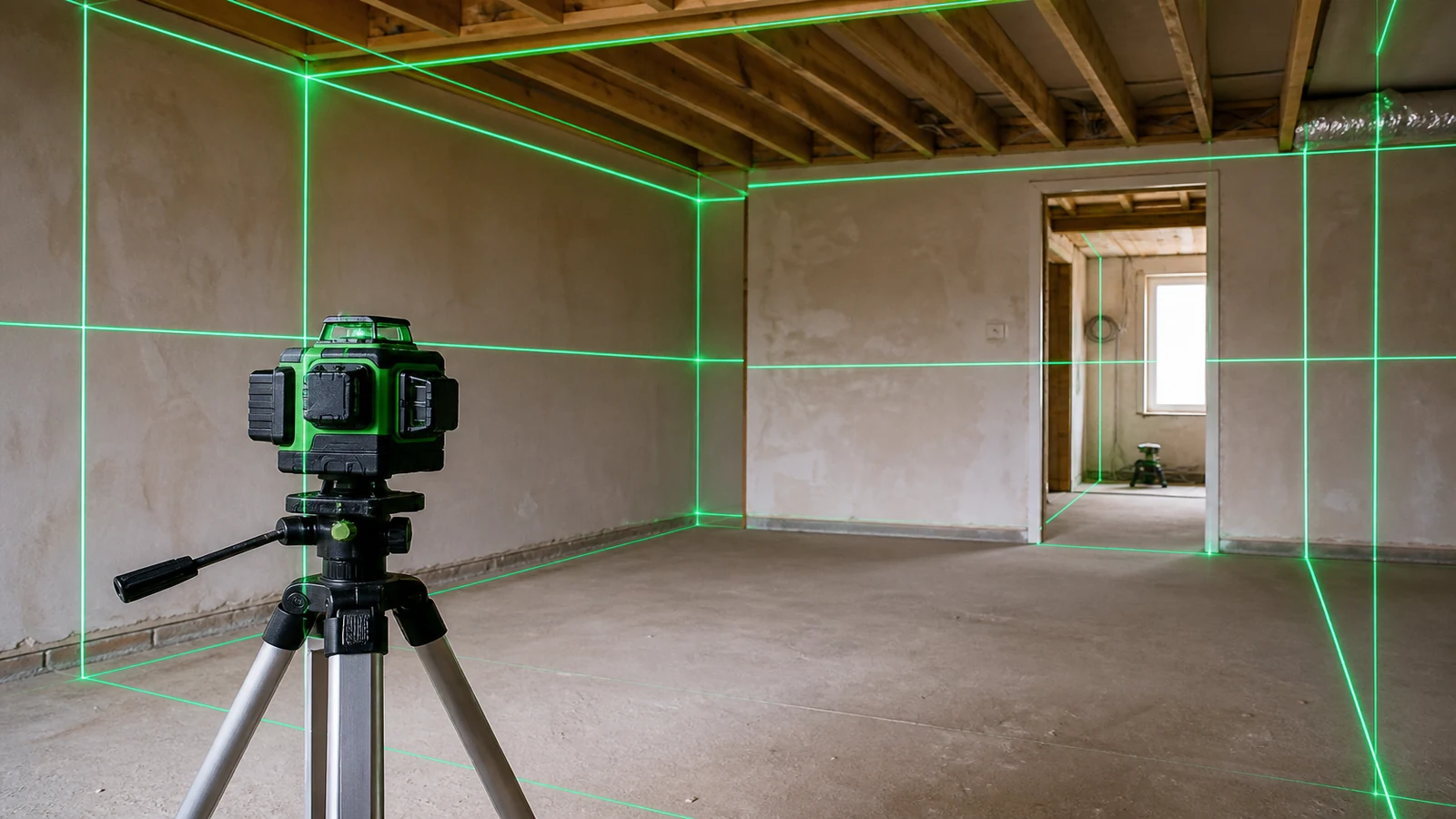
4D 16 line laser level UK: what the label means in practice
Short answer: “4D” and “16-line” are usually marketing shorthand for a multi-plane laser that can project four 360° planes—often two horizontal planes, including one close to the floor, and two vertical planes. It describes coverage, not a universal technical standard. Check the selected model’s manual and line-selection controls before assuming exactly which planes are available.
Translate the label into a job
The useful question is not “do I need sixteen lines?” but “which reference must stay visible while I work?” A floor-near horizontal line can help set tile layout. A higher horizontal line can keep a wall datum consistent. Vertical planes can help carry a plumb reference up a wall or across a room. UK tiling guidance on multi-plane laser levels for tiling describes this kind of 360° coverage as a way to establish floor and wall datums.
In marketplace titles, the “4D” phrase can make two products sound identical when their controls, mounting options and included accessories are not identical. UK round-ups do use 4D/16-line wording as a product category, as this UK laser-level category roundup shows. Treat the wording as a starting point for comparison, not as proof of the exact configuration you need.
Use this buying checklist
- Floor layout: Do you need a line close to the floor for tiles or another low datum? If not, a simpler unit may be enough.
- Wall count: Are you moving around several walls, or staying in front of one wall? A room-wide task is the stronger case for 360° coverage.
- Vertical references: Do you need plumb lines at the same time as a horizontal datum for tracks, cabinets or tile set-out?
- Mounting: Can you position the tool at the necessary height and keep it stable? Check the actual thread, bracket and tripod details for the chosen variant.
- Kit contents: Are batteries, charger, case and a suitable support included in the variation you are comparing? Do not infer them from a headline.
- Environment: Is the job indoors? True long-distance outdoor levelling is a different workflow and can require purpose-built equipment and a receiver.
When fewer planes are the better buy
Choose fewer planes when the task is genuinely narrow: one picture row, one shelf run or one feature wall. A simple cross-line is easier to place and has less to configure. Our cross-line versus 360° comparison helps with that first decision.
Choose a multi-plane tool when your layout keeps crossing corners or mixing floor, wall and ceiling references. This is common in renovation set-out, but it is still worth defining the exact line you will use before paying for a larger bundle.
Do not use the label to make unsupported comparisons
A 4D label does not by itself establish accuracy, runtime, dust resistance, outdoor range or superiority over a named brand. Those are model-specific facts. Avoid judging a product by line count alone; compare the manual, the variation contents and the demands of your room.
If your answer to the checklist is that you need multi-plane indoor coverage, you can inspect this site's 16-line green laser level kit as a conditional fit check. If your job is an occasional picture or one straight shelf, stop there—a simpler tool is likely the more useful choice.
Plan the support as well as the beam
Multi-plane coverage is only useful if the laser can be placed where the references need to appear. Before buying, decide whether a compact tripod, wall bracket or another stable support suits the room. The laser level with tripod kit checklist explains the questions to ask without assuming every bundle contains the same parts.