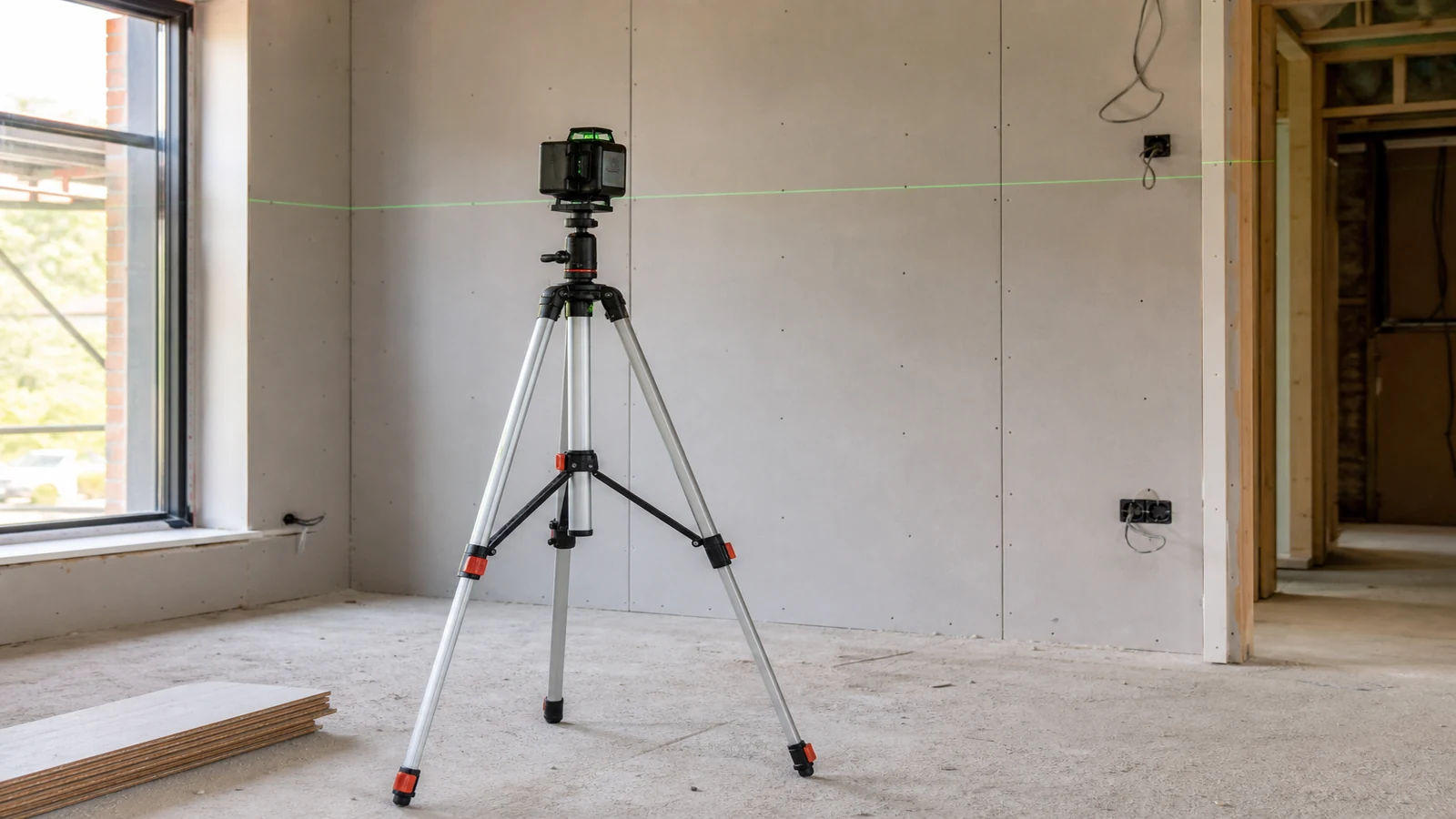
Laser level with tripod kit UK: compare the whole working setup
Short answer: do not compare only the laser head or the headline price. Check that the selected variation gives you a stable way to position the laser at the height of your job, compatible mounting, enough power for the work session, a charger suitable for the UK and practical storage. A bare laser that needs several add-ons can be less convenient than a correctly matched kit.
Start with the job height
Ask where the line must land: near the floor for tile layout, at mid-wall for shelves or cabinets, or near a ceiling for a room reference. A compact tripod can be practical for many indoor jobs, but it will not automatically reach every working height. Measure the intended datum before deciding that a 1.2 m tripod, a taller stand or a wall mount is appropriate.
Tripod-selection guidance highlights both working height and the need to match the mounting thread—for example, whether a tool uses a 1/4-inch or 5/8-inch fitting. Read the tripod compatibility guide before treating any tripod as interchangeable.
Complete-kit checklist
- Mounting fit: Verify the laser’s thread and whether the tripod or bracket actually matches it.
- Useful height: Check the stated working height against the line you need, not just against a product photo.
- Stable placement: Confirm there is room to spread the tripod safely and that the floor is suitable.
- Power: Read the selected variation to see how many batteries, which charger and which cable or plug are actually included.
- Line controls: Make sure you can select the reference you need rather than paying for modes that will stay unused.
- Case and transport: A case matters if the kit will move between rooms or jobs; inspect the listing rather than assuming one is bundled.
- Returns and support: Check the seller’s current terms before buying, especially if the kit is for a one-off project.
Some UK buying guides caution that the apparent price of a laser can omit items such as a tripod or detector. This UK laser-level buying guide is a reminder to total the parts needed for your workflow, rather than comparing headlines alone.
Match the support to the task
For a weekend DIY project, a compact, easily moved support may be the most useful option. For repeated room layout, a taller and steadier support can save resets if it reaches the references you use every day. For floor-only work, a tall tripod may add little; a low support or purpose-made lifting arrangement can be more practical.
Do not buy a tall stand simply because it sounds more professional. The right support is the one that reaches the line, fits the room and keeps the laser stable without becoming an obstacle.
A simple before-you-buy test
- Write down the highest and lowest line you expect to need.
- Check the selected laser variation’s mounting and included parts.
- Check the support’s mounting specification and usable height.
- Decide whether you can work safely from that position in your actual room.
- Only then compare the total cost of complete options.
If you have already decided that multi-plane indoor coverage is needed and want to compare a complete option, you can view this site's 16-line green laser level kit. Check the live product-detail variation carefully; this is relevant only when its current contents match the checklist above.
When to stop
Skip a tripod bundle when your task needs only a single low reference that a smaller support handles safely, or when an outdoor layout requires specialist equipment rather than an indoor tripod setup. A tripod improves placement; it does not turn the wrong laser format into the right one. For that earlier choice, use the cross-line versus 360° decision guide.