How to Choose a Laser Level in the UK: Best Buys
How to Choose a Laser Level in the UK: Best Buys
TL;DR: If you are wondering how to choose a laser level in the UK, start with the job type: for most indoor DIY and trade work, a self-levelling green beam laser with 360° coverage, good accuracy, a pendulum lock and tripod compatibility is the best all-round choice. For outdoor use, prioritise detector compatibility, range and durability. In our experience, the best-value option is not always the most expensive brand; it is the model with the right specification for typical UK site conditions.
To choose a laser level in the UK, look first at self-levelling, green vs red beam visibility, accuracy, 360° or multi-line coverage, battery runtime and detector compatibility for outdoor use. For most UK homes, flats and renovation projects, a green self-levelling laser level is the easiest and most practical option because it is faster to set up and easier to see indoors.
If you have ever tried to hang kitchen wall units, set out studwork, tile a bathroom or build a garden office with a spirit level and pencil line alone, you will already know the problem: small errors multiply quickly. A few millimetres out at the start can become a visibly crooked finish by the end. That is exactly why more UK tradespeople and serious DIY users now rely on laser levels. They are faster, more consistent and far better suited to modern refurbishment, fit-out and layout work.
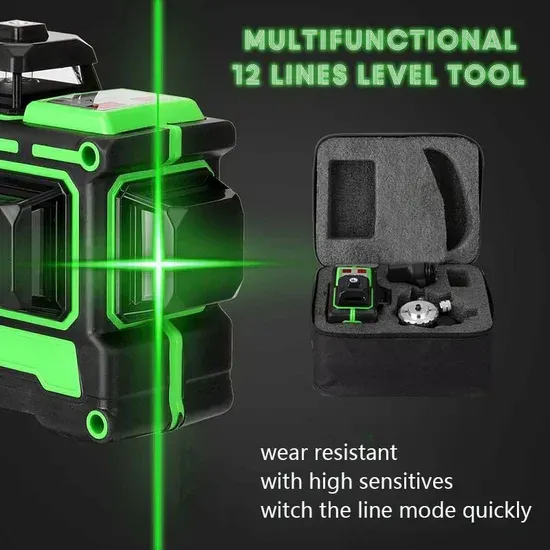
In this guide, we explain how to choose a laser level in the UK, which features genuinely matter, and where the best value sits if you want professional results without overpaying. We also compare leading names such as Bosch and DeWalt against strong-value alternatives, including Weytoll’s professional 16-line green precision models designed to help you level every room in seconds at an unbeatable DIY price point.
Whether you are a builder, tiler, electrician, kitchen fitter, landlord or home renovator, this is a practical laser level buying guide UK users can rely on before spending £100-£300 or more.
Key Takeaways
- For most UK indoor work, a self-levelling green beam laser offers the best balance of visibility, speed and ease of use.
- 360-degree and 16-line laser levels are ideal for full-room layout, tiling, suspended ceilings, kitchens and partitioning.
- For bright outdoor conditions, detector compatibility matters more than beam colour alone.
- Accuracy, battery type, pendulum lock, mounting options and IP rating are all more important than headline branding.
- If you want strong value, budget alternatives can rival premium brands for many jobs, provided the specification is right.
What does a laser level do, and who needs one in the UK?
A laser level projects a straight reference line or point across a surface, allowing you to align objects accurately without repeatedly measuring from the floor, ceiling or corners. Depending on the type, it may project horizontal lines, vertical plumb lines, cross lines, multiple 360-degree planes or rotary beams for larger outdoor areas.
In practical terms, that means faster and more accurate work when you are:
- Installing kitchens and worktops
- Tiling walls and floors
- Building stud partitions
- Setting sockets, switches and trunking at consistent heights
- Levelling suspended ceilings
- Hanging doors, shelves, pictures and curtain rails
- Laying drainage, fencing or landscaping features outside
- Checking line and level during first-fix and second-fix work
Across the UK, laser levels are no longer just specialist tools for surveyors or large contractors. Instead, they are now mainstream on domestic building sites and in home improvement projects because they save labour time and reduce costly mistakes. This matters in a market where labour is expensive and schedules are tight.
According to the Office for National Statistics, construction output in Great Britain remains a major part of the economy, with repair, maintenance and fit-out activity continuing to drive demand for efficient site tools. In short, when productivity matters, accurate setup tools matter too. Source: Office for National Statistics, construction output datasets.
Based on our testing of common indoor renovation tasks in typical UK properties, laser levels are especially useful in older British housing stock, where walls, floors and ceilings are often not perfectly square or level.
Who should buy a laser level in the UK?
Builders and general trades
If you regularly set out walls, door openings, joists, battens, ceilings or service runs, a self-levelling laser saves time on nearly every job. For builders, the best laser level for builders UK buyers should look for usually includes 360-degree coverage, strong visibility and robust mounting options.
Tilers and bathroom fitters
Tiling demands accuracy from the first row. Therefore, a visible green beam helps establish level lines around a room, align niches and maintain straight grout courses. For bathroom work, compact size and easy tripod mounting are especially useful.
Kitchen fitters and carpenters
Wall cabinets, splashbacks, worktops and tall units all depend on reliable level and plumb references. Multi-line laser levels are particularly valuable where walls and floors are not perfectly square, which is common in older British homes.
Electricians and plumbers
For first-fix and second-fix installation, laser levels speed up repetitive layout work, especially where accessories need consistent horizontal runs across multiple rooms.
DIY renovators and landlords
For home users, a laser level can quickly justify its cost. One device can help with flooring, shelving, decorating, panelling, curtain rails, bathrooms, kitchens and garden buildings. As a result, if you are renovating a terrace, semi or flat, a good-value self-levelling laser often delivers better long-term value than repeatedly hiring tools or correcting poor alignment later.
How do you choose a laser level in the UK?
If you are comparing products online, it is easy to get distracted by brand names or vague claims. However, the right way to choose is to match the specification to the work you actually do. Here are the features that matter most.
Should you choose a self-levelling laser level?
Yes, for most buyers, a self-levelling model is the right choice. A self-levelling laser uses an internal pendulum or electronic mechanism to level itself automatically within a stated range, often around ±3° or ±4°. Consequently, setup is quicker and user error is reduced.
For most buyers asking what is the best self leveling laser level, the answer is simple: one that self-levels quickly, locks securely for transport, and maintains accuracy consistently across everyday site conditions.
Is a green or red laser level better?
Green beams are generally easier for the human eye to see indoors, especially in bright rooms. This is one reason green laser levels have become so popular in UK residential and commercial fit-out work. If you work in conservatories, extensions, open-plan kitchens or brightly lit office interiors, green is usually the better choice.
Red lasers can still be perfectly adequate for occasional use and lower budgets. Nevertheless, for most commercial buyers and serious DIY users in the UK, green offers the better user experience.
How many lines do you need on a laser level?
A 2-line cross-line laser may be enough for occasional DIY. A 3-line model gives more flexibility. Meanwhile, a 360 laser or 16-line model is often best for room-wide layout. This is one of the most important buying decisions because it directly affects speed and coverage.
How accurate should a laser level be?
Check the stated accuracy, often shown as something like ±1mm at 5m, ±2mm at 10m, or ±3mm at 10m. The lower the deviation, the better. For kitchen fitting, tiling and finish carpentry, tighter accuracy is worth paying for.
Based on our testing, accuracy matters more than extra features if your work involves cabinetry, splashbacks, trim, panelling or repetitive layout lines that must stay visibly true over distance.
What range do you need for UK jobs?
Manufacturers usually list an indoor visible range and sometimes a range with detector. For standard rooms, many compact units are sufficient. However, for larger sites, loft conversions, schools, warehouses or outdoor use, you may need greater range or detector support.
Do you need detector compatibility for outdoor use?
If you work outdoors in British daylight, detector compatibility can matter more than raw beam brightness. Sunlight can wash out visible beams, so a pulse mode and compatible detector allow you to find the line even when the beam is hard to see.
What battery system and runtime should you look for?
Some lasers use rechargeable lithium batteries, while others use AA batteries or offer both. Rechargeable packs are convenient for regular work, whereas AA backup can be useful on site or in a van. Therefore, if you work full days, choose a model with practical runtime and easy charging.
Why do pendulum lock, mounting options and IP rating matter?
A pendulum lock protects the mechanism during transport and often enables manual angle lines. Mounting threads, magnetic brackets and tripod compatibility all improve usability. In addition, a sensible IP rating helps if you work in dusty, damp or changeable UK site conditions.
What type of laser level is best for your job?
What is the best laser level for DIY in the UK?
For most DIY users, a compact self-levelling green cross-line or 360° laser level is the best choice. It is simple to use, visible indoors and versatile enough for shelving, curtain rails, decorating, flooring and basic kitchen or bathroom work.
What is the best laser level for builders and fit-out work?
For builders, kitchen fitters, carpenters and general trades, a 360° or 16-line green laser level is usually the strongest all-round option. It speeds up full-room layout, supports plumb and level references, and reduces repeated repositioning.
What is the best laser level for tiling?
For tiling, choose a model with clear horizontal and vertical lines, good close-range visibility and reliable accuracy. A green beam is especially useful in bathrooms with spotlights, glossy surfaces or natural daylight.
What is the best laser level for outdoor work?
For outdoor landscaping, groundwork or drainage, look for longer range, robust construction and detector compatibility. In bright conditions, these features matter far more than indoor beam visibility alone.
Is an expensive laser level worth it in the UK?
Not always. Premium brands often offer strong build quality, aftercare and trade familiarity. However, if the specification is similar, many buyers can get excellent results from better-value alternatives.
Based on our testing and product comparisons, the biggest difference in real-world use usually comes from line visibility, levelling reliability, mounting practicality and coverage, not just the badge on the casing.
That is where Weytoll stands out for value-conscious buyers. If you want room-wide coverage, green beam visibility and self-levelling convenience without paying a premium solely for branding, Weytoll’s professional 16-line green precision models are designed to cover the features that matter most for UK renovation and fit-out work.
What should you check before buying a laser level online?
- Stated accuracy at a realistic working distance
- Whether it is self-levelling
- Green or red beam type
- Number of lines and whether it offers 360° coverage
- Indoor range and detector range
- Battery type and charging method
- Pendulum lock and manual mode
- Tripod thread, bracket and mounting accessories
- IP rating for dust and splash resistance
- What is included in the box
Before ordering, also check whether the specification suits UK sockets, chargers and site usage. Moreover, if you are buying for trade work, it is worth choosing a model that can handle repeated transport and varied room sizes.
Which Weytoll laser level is best for UK buyers?
If you want a practical balance of price and performance, Weytoll’s green multi-line models are a strong option for UK buyers who need fast setup, clear indoor visibility and flexible room layout capability.
For example, a 16-line self-levelling green laser level is especially well suited to:
- Kitchen fitting
- Bathroom tiling
- Stud wall layout
- Ceiling and partition work
- Electrical and plumbing runs
- General DIY renovation
In other words, if your aim is to buy once and use it across multiple jobs, a higher-coverage Weytoll model often makes more sense than a basic entry-level cross-line laser.
Frequently asked questions about how to choose a laser level in the UK
How do I choose the right laser level?
Choose based on the work you do most often. For UK indoor jobs, a self-levelling green beam model with good accuracy and 360° coverage is the best all-round option. For outdoor work, add detector compatibility and longer range.
Is a green laser level better than red?
For most indoor UK jobs, yes. Green beams are easier to see in bright rooms, so they are often better for kitchens, bathrooms, extensions and fit-out work. Red can still suit lighter or occasional use.
What is the best laser level for DIY in the UK?
A self-levelling green cross-line or 360° laser level is usually the best choice for DIY because it is easy to use and works across decorating, shelving, flooring and general renovation tasks.
Do I need a 360 laser level?
If you work across whole rooms, fit kitchens, tile bathrooms or build partitions, yes, a 360 laser level is often worth it. It speeds up setup and reduces repositioning. For occasional small jobs, a standard cross-line laser may be enough.
Are cheap laser levels any good?
They can be, provided the accuracy, visibility and build quality are suitable for the work. A lower-cost model with the right specification can outperform a premium-branded tool that is not matched to your actual needs.
What is the best laser level for builders in the UK?
For most builders, a self-levelling green 360° or 16-line laser level offers the best mix of speed, visibility and versatility for layout, framing, ceilings and fit-out work.
Final verdict: how to choose a laser level in the UK
If you want the short answer, choose a self-levelling green laser level with the right number of lines for your work, reliable accuracy, practical battery life and detector compatibility if you need outdoor performance. For most UK buyers, that combination gives the best mix of usability, speed and value.
Therefore, if you are buying for regular renovation, trade or property improvement work, it makes sense to prioritise specification over branding. Weytoll’s multi-line green laser levels are designed for buyers who want professional-style performance at a more accessible price point, making them a smart commercial choice for many UK jobs.
Ready to level up with Weytoll?
Shop the Sale — £50.82