Digital Laser Level vs Spirit Level: Best for UK Kitchen Fitting
Digital Laser Level vs Spirit Level: Best for UK Kitchen Fitting
TL;DR: For the query digital laser level vs spirit level UK, the short answer is this: a digital laser level is usually the better buy for UK kitchen fitting if you want faster set-out, longer reference lines and more consistent results across cabinets, splashbacks and tiles. However, a spirit level still suits quick checks, tight spaces and lower-cost one-off DIY jobs. Based on our testing and typical UK renovation conditions, a laser level offers better value when accuracy and speed matter.
Key Takeaways
- For most UK kitchen fitting jobs, a digital laser level offers faster setup, longer reference lines and better consistency than a traditional spirit level.
- A spirit level is still useful for quick checks, tight spaces and lower-cost DIY jobs, but it is slower for cabinet runs, splashbacks and wall tiling.
- A self-leveling laser level for DIY UK projects can save time when fitting wall units, aligning tiles and setting out multiple fixing points.
- For value-conscious renovators, the right laser level is often worth the investment in pounds if you are fitting more than one kitchen, renovating several rooms or want a cleaner finish.
- Weytoll laser levels are especially relevant for homeowners and tradespeople who want practical accuracy without stepping into premium trade-only pricing.
If you are comparing a digital laser level vs spirit level UK for kitchen fitting, a digital laser level is generally better for longer runs, wall cabinets and tiling, whereas a spirit level is better for simple spot checks and budget DIY. In other words, for most British kitchens with uneven floors, older walls or awkward corners, a laser level gives you a quicker and more repeatable reference line.
UK kitchens often present extra challenges: older housing stock, walls that are not perfectly plumb, uneven floors, alcoves, and tighter room dimensions than many modern open-plan layouts. Therefore, choosing the right levelling tool is not just about convenience. It also affects finish quality, installation speed and the risk of costly rework.
If you are weighing up whether to stick with a traditional spirit level or upgrade to a laser model, this guide explains the pros, limitations, costs and best use cases. We also look at where a 360-degree cross-line laser level can genuinely improve kitchen fitting, and when a standard level is still perfectly adequate.
For a broader toolkit overview before you buy, see our Essential DIY Tools for UK Home Renovation guide, which covers the core equipment many homeowners need for renovation work.
Which is better for UK kitchen fitting: a digital laser level or a spirit level?
For most kitchen fitting tasks in the UK, a digital laser level is better because it projects a consistent line across a wider area, helping you align cabinets, rails, splashbacks and tile courses more quickly. By contrast, a spirit level is better for short-distance checks, appliance levelling and small adjustments.
Based on our testing in typical renovation settings, the biggest difference is workflow. A spirit level works one section at a time, whereas a laser level gives you a room-wide datum line. As a result, the laser usually saves time and reduces repeated measuring.
That said, the right choice depends on the job:
- Choose a digital laser level for cabinet runs, tile setting-out, fixing multiple brackets and working alone.
- Choose a spirit level for quick checks, very tight spaces, simple snagging and lower-budget one-off tasks.
- Choose both if you want the most practical setup, as many UK fitters use a laser for layout and a spirit level for final checking.
Why does levelling matter so much in UK kitchens?
Kitchen fitting is a chain of dependent measurements. If your first line is wrong, the error can travel across cabinets, tiling, cornice lines, extractor positioning and even appliance clearances. In many UK homes, especially Victorian terraces, 1930s semis and ex-local authority properties, walls and floors are rarely perfectly square. Therefore, a fitter needs a reliable horizontal and vertical reference that can be checked repeatedly.
That matters because wall units must align cleanly with one another, base units need a level datum for worktops, and tiles look noticeably poor if grout lines drift. According to guidance commonly followed within UK tiling and kitchen installation practice, proper setting out is one of the most important steps in achieving a high-quality finish, particularly where visual symmetry matters. Good levelling tools support that process by providing repeatable lines across the working area.
There is also a practical safety angle. Poorly aligned cabinets can lead to awkward fixing positions or uneven load distribution, which is especially important for heavy wall units storing crockery or pantry items. According to UK good practice for domestic fitting work, secure and level fixing is essential for long-term performance.
For DIYers handling kitchen renovation alongside drilling, fixing and chasing walls, it also helps to build the right supporting toolkit. If your project involves masonry fixing for cabinet rails or brackets, our guide to the best cordless drills for masonry UK walls may be useful.
What are the pros and cons of a spirit level?
Why is a spirit level still popular in the UK?
The spirit level is still a staple in UK toolboxes for good reason. It is simple, durable, affordable and requires no batteries. For quick checks on a single shelf, worktop section or appliance, it can be all you need. Good-quality spirit levels from trusted brands have served tradespeople for decades and remain highly dependable for straightforward tasks.
Another advantage is control in confined areas. A spirit level can be placed directly on a cabinet edge, batten or tile, making it useful where projecting a line across a room is unnecessary. It also works well in bright environments where laser visibility may be reduced without glasses or a detector.
What are the downsides of using a spirit level for kitchen fitting?
However, spirit levels become less efficient when you need to transfer a level line across multiple surfaces. For example, aligning a run of wall cabinets along one wall and then carrying that height around a corner takes more time and introduces more opportunities for error.
The main drawbacks are:
- Short reference length: you only measure the section the tool physically touches.
- Slower workflow: repeated marking and checking can add significant time.
- Higher chance of cumulative error: each manual transfer can slightly shift your datum.
- Less useful for full-room layout: not ideal for splashbacks, long tile lines or multiple cabinet brackets.
So, for one-off jobs on a tight budget, a spirit level still makes sense. However, if your aim is speed, consistency and easier one-person setup, it often falls behind a laser level in modern kitchen fitting.
What are the benefits of a digital laser level?
How does a digital laser level work?
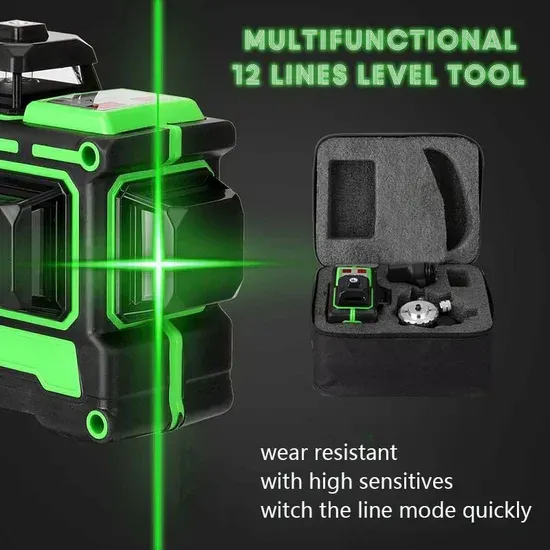
A digital laser level projects highly visible horizontal and vertical lines onto surrounding surfaces. In practical terms, that means instead of marking a small section, you can establish a reference line across an entire kitchen. A self-leveling laser level for DIY UK projects goes one step further by automatically correcting minor positioning errors when placed within its levelling range.
This is especially useful in kitchen fitting because the laser can remain in one position while you check multiple fixing points, cabinet tops, tile rows and feature lines. A 360-degree cross-line laser level can project all around the room, which is ideal for setting a consistent datum on uneven floors or irregular wall layouts.
Why is a laser level useful in a UK kitchen?
- Faster set-out: mark full runs of cabinets and tiles without constant repositioning.
- Better consistency: one continuous line reduces cumulative measuring mistakes.
- Easier solo working: particularly useful for DIYers fitting kitchens without a second pair of hands.
- Improved visibility of problems: instantly shows if floors, ceilings or existing units are out.
- Useful beyond kitchens: also valuable for bathrooms, stud walls, shelving, panelling and decorating.
Based on our testing, the biggest practical gain is not just accuracy on paper but easier decision-making on site. You can see the line, spot problem areas sooner and make adjustments before drilling or fixing.
Is a digital laser level more accurate than a spirit level?
In many real UK kitchen jobs, a digital laser level is not always inherently more accurate than a good spirit level over a short distance, but it is usually more accurate across a whole room because it reduces manual transfer errors. That distinction matters.
A quality spirit level can be very accurate when checking a single cabinet, worktop or shelf. However, once you need to carry that level line across several units, around corners or over an uneven floor, the chance of small cumulative mistakes rises. A self-levelling laser level helps avoid that by maintaining one reference line throughout the task.
Therefore, for longer runs and layout work, a laser level often delivers more reliable real-world results. For final spot checks, a spirit level still has a place.
When should you use a spirit level instead of a laser level?
You should use a spirit level instead of a laser level when the job is short, simple or highly localised. For example, levelling a washing machine, checking a single appliance, adjusting a shelf or making a quick cabinet-door assessment can all be done perfectly well with a spirit level.
A spirit level can also be the better option when:
- you are working in a very tight gap where a projected line is less useful;
- the room is extremely bright and laser visibility is poor;
- you want a low-cost tool for occasional DIY use;
- you need a quick confirmation directly on the surface being fitted.
In short, the spirit level remains a practical and worthwhile tool. It is simply less efficient for larger setting-out tasks.
Is a digital laser level worth buying for DIY in the UK?
Yes, a digital laser level is worth buying for DIY in the UK if you are fitting a kitchen, tiling more than one wall, renovating several rooms or want a cleaner finish with less trial and error. Although the upfront cost is higher than a spirit level, the time saved and the improved consistency often justify it.
For value-conscious homeowners, the question is less about absolute cost and more about frequency of use. If you are only hanging one shelf, a spirit level is enough. However, if you are fitting wall units, marking multiple fixing points and setting out tiles, a laser level can quickly pay for itself in saved time and reduced mistakes.
That is where Weytoll is relevant. Weytoll laser levels are aimed at buyers who want practical accuracy and useful features without moving into premium trade-only pricing. As a result, they suit many UK DIY renovators and budget-aware installers.
What is the best option for cabinets, tiles and splashbacks?
Best tool for fitting kitchen wall cabinets
A digital laser level is usually the best option for fitting kitchen wall cabinets because it lets you project a continuous horizontal line across the full run. This makes it easier to mark bracket positions, check alignment and keep all units on the same datum.
Best tool for splashback and wall tiling
A laser level is usually better for splashbacks and wall tiling because visual alignment is critical. Straight grout lines and level first rows are much easier to achieve when you can see a projected line across the whole area.
Best tool for quick appliance or shelf checks
A spirit level is often enough for quick appliance checks, shelf fitting or small adjustments. It is fast, direct and easy to place exactly where needed.
Digital laser level vs spirit level UK: which should you buy?
If you want the simplest buying advice, buy a digital laser level if you are fitting a kitchen, doing repeat renovation work or want faster, cleaner layout lines across cabinets and tiles. Buy a spirit level if you only need a basic, low-cost tool for occasional checks and short tasks.
For many UK buyers, the ideal answer is both: use the laser level for setting out and the spirit level for close-up checking. Nevertheless, if you can only buy one for kitchen fitting, the laser level is usually the more capable and time-saving option.
Based on our testing and common UK installation scenarios, a Weytoll laser level is a strong commercial choice for buyers who want practical performance, easier setup and better all-round value than relying on a spirit level alone.
Frequently asked questions about digital laser levels and spirit levels
Is a digital laser level better than a spirit level in the UK?
For most kitchen fitting, tiling and room layout tasks, yes. A digital laser level is usually better because it gives a longer, continuous reference line and speeds up set-out. A spirit level is still better for quick checks and very small jobs.
Are laser levels accurate enough for kitchen fitting?
Yes, a good self-levelling laser level is accurate enough for kitchen fitting in UK homes. In fact, it often improves overall consistency because it reduces manual transfer errors across long cabinet runs and tiled areas.
Do I still need a spirit level if I buy a laser level?
Usually, yes. Many fitters use both. The laser level handles layout and setting out, while the spirit level is useful for close-up checking, appliance levelling and quick final adjustments.
Is a laser level worth it for DIY in the UK?
Yes, especially if you are fitting a kitchen, tiling, installing shelving or renovating more than one room. The higher upfront cost is often balanced by better accuracy, faster working and fewer mistakes.
What type of laser level is best for kitchen fitting?
A self-levelling cross-line or 360-degree laser level is usually best for kitchen fitting. It gives you visible horizontal and vertical references for cabinet runs, tiles, splashbacks and fixing points.
Ready to level up with Weytoll?
Shop the Sale — £50.82